HILL, LEONARD WILLIAM
1911 - 1981 from England
naturalist, businessman and 'Administrator' of the Jason Islands. Leonard William Hill was born on 27 December 1911 in Gloucestershire, the son of Alfred William Hill, a groundsman and Margaret Elizabeth, née Meakin. His parents did their best to encourage his early interest in the natural world but they were of modest means. Hill left school at fifteen and was apprenticed as a carpenter but it was an industrial accident in which he lost two fingers that proved to be the unusual starting point for the fortune that he went on to create.
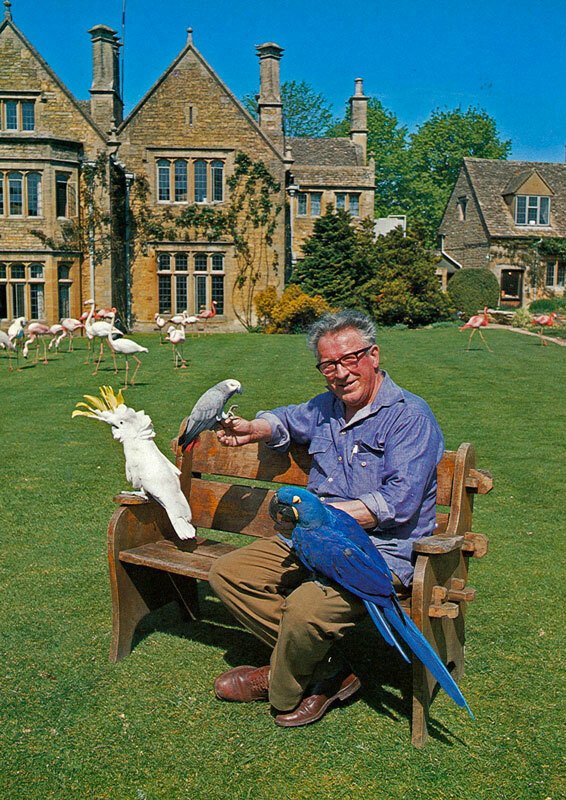
Len Hill
Investing his awarded damages in war bonds he was able to buy a house for himself and wife Nellie Laura, née Clifford, whom he had married in St Edward's, Stow on the Wold parish church on 3 October1934. The couple were to have three children, Rosemary, Richard and Margaret Ann who died in 1966 at the early age of 30.
Opting for self-employment, the demand for Hill’s services was such that he set up his own building company with a growing number of employees. During World War II he turned his flexible entrepreneurial skills to the production of wooden bomb nose-caps and coat hangers, and even supplied vegetables in quantity to the local air base at Little Rissington.
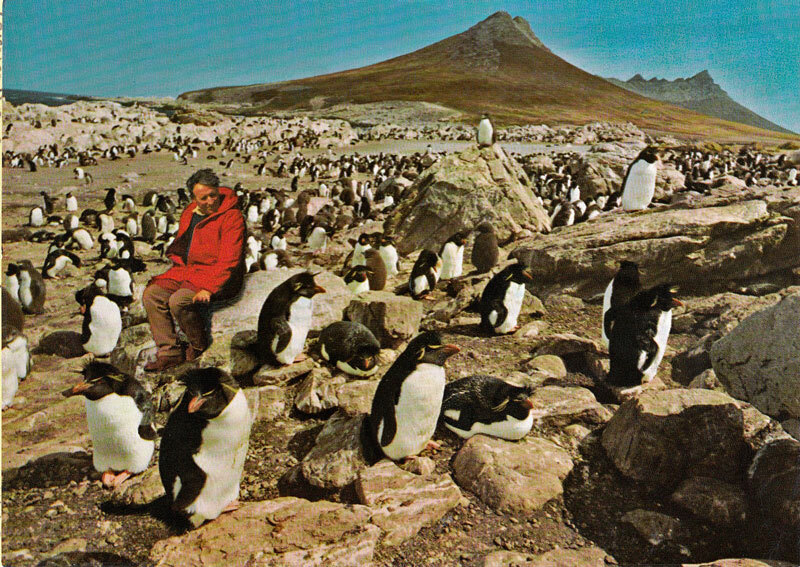
Len Hill on Grand Steeple Jason...
No ordinary bird-lover, Hill put aside his successful building company to realise his boyhood dream of creating his own bird sanctuary. Even more impressively, he established the Birdland Zoo Gardens in the same Tudor manor house, Chardwar, in the Cotswolds showplace village of Bourton-on-the-Water, Gloucestershire where he had once worked as a boot boy and lived with his parents in a small cottage attached to the stable yard.
The ‘Birdland Zoo Gardens’ was established in 5 acre grounds in June 1957. The attraction housed around 1,200 birds from more than 20 countries of origin with a lecture room to educate visitors on their lives and habitats. Hill was an effective fundraiser for the World Wildlife Fund and his growing reputation led to television appearances and speaking tours.
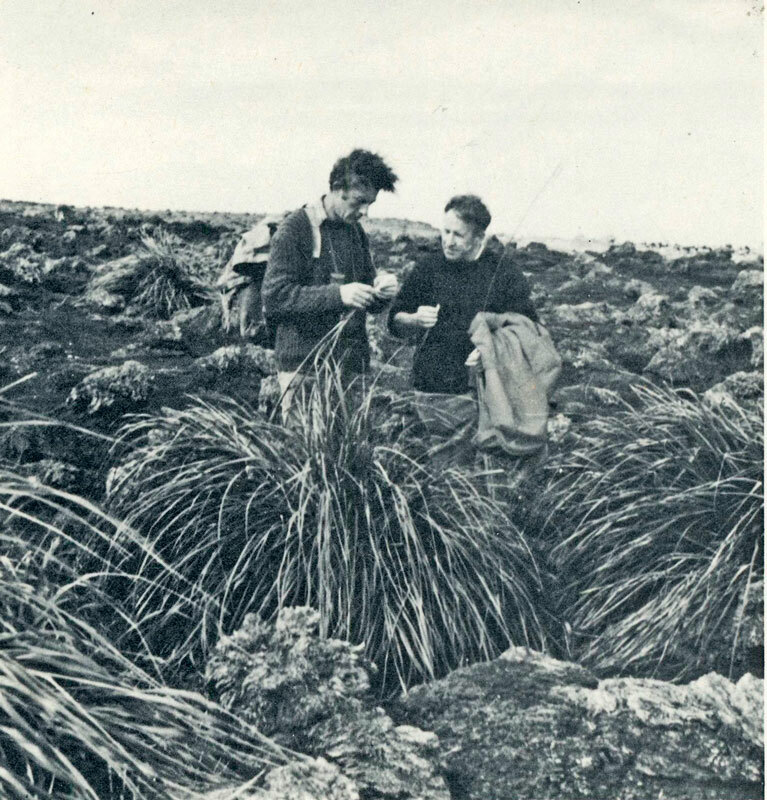
Len Hill with Ian STRANGE
In 1968 Hill joined conservationist Peter SCOTT on what has been described as the earliest tourist trip to the Antarctic. Scott was already a household name, his BBC natural history series Look having been broadcast since 1955. Calling at Stanley, Hill met in person the senior chaplain at Christ Church Cathedral, Peter MILLIAM, who had previously assisted with the export of 60 king penguins from South Georgia to England. Just one bird died in transit and in recognition of Millam's assistance Hill:
A devout Churchman, presented the Cathedral with a beautiful all-seasons tapestry cope, and also gave a sum of money towards improving heating in the Deanery.’(Falkland Islands Monthly Review No. 137, March 1970, pp 12-13).
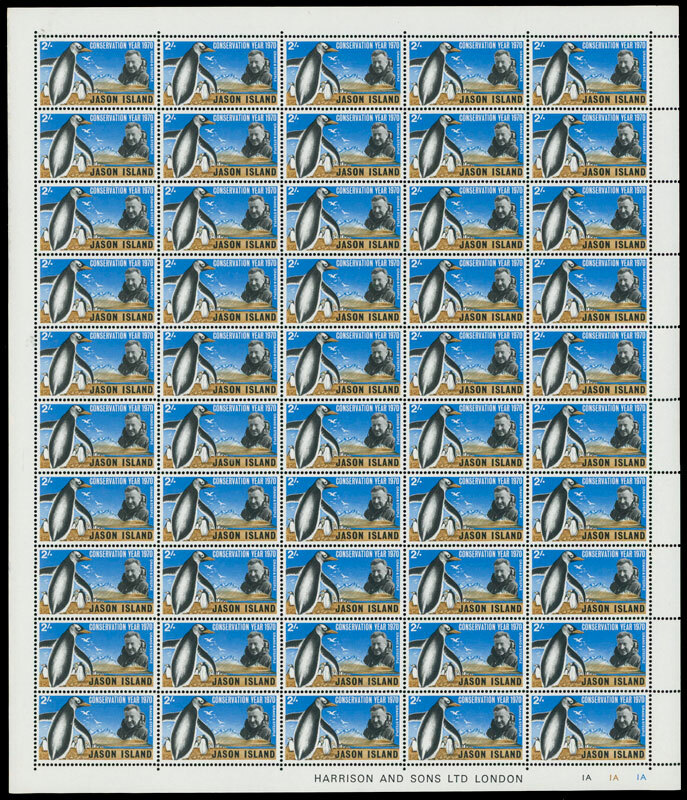
Sheet of Jason Islands stamps
The voyage continued with a visit to Deception Island which had recently experienced a violent volcanic eruption opening new vents along a 5-kilometre fissure. Hill observed the sea 'still boiling with sulphur'.
A few months after his return to England Hill encountered by chance Arthur Grenfell BARTON who had become a friend during the visit to the Falklands. 'Barty' told Hill of the availability of the two Jason islands which had already been advertised in the Daily Telegraph without response. The asking price of £10,000 included sheep that had been stocked there by the previous owners but this was an additional responsibility that Hill did not find attractive. After some negotiation, Hill bought the two islands for £5,500 from Dean Brothers Ltd, without the sheep but including the millions of birds who teemed on Steeple Jason and Grand Jason, the largest islands in the group.
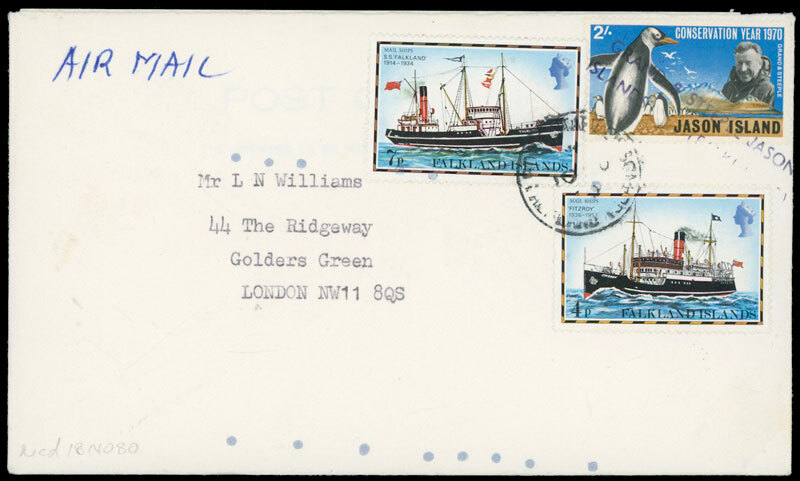
Post card bearing Jason Island stamp
The Falkland Islands Monthly Review of 6 April1970 reported:
A retired builder and amateur naturalist, Mr. Len Hill, has bought the Grand Jason and Steeple Jason Islands in the Falkland Islands. The Islands cost him 10/- an acre, and on these Mr. Hill will study the 500,000 penguins, a colony of albatrosses, and some rare hawks. Mr. Hill visited the Islands en route to the Antarctic on a tourist ship. Three types of penguins nest on the Grand and Steeple, the rockhopper, the gentoo and the jackass. Mr. Hill will probably visit his Islands once a year.
Ahead of his first visit to his new properties in 1970 Hill arranged for Ian STRANGE to visit the islands in MV Forest and set up living accommodation and rations. Animal grazing had damaged substantial areas of valuable tussac grass but Strange felt the islands to be of vital importance for the preservation of the Falklands’ natural wildlife.
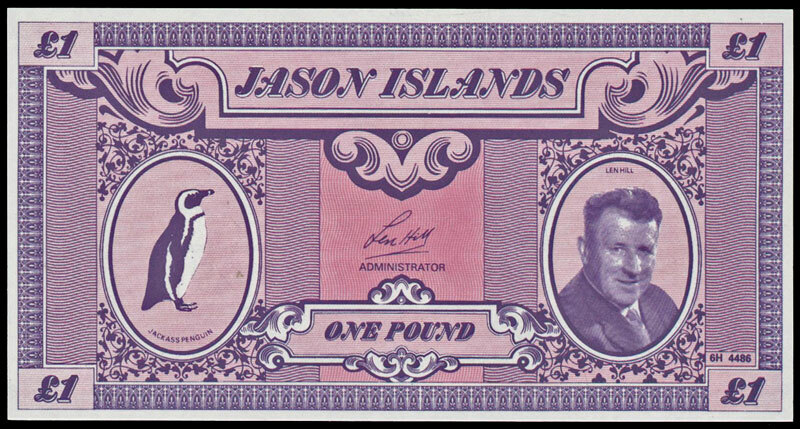
1 Jason Island currency
On 9 November1970 the Colonial Secretary's Office granted Strange, on behalf of Hill, an export licence for 100 rockhopper penguins, 20 gentoo penguins and 4 king shags, assurances having being given that these comprised only immature birds. A fee of £1,840 was agreed.
The purchase of the islands had left Hill's finances extremely stretched and in response he had decided to produce his own postage stamp, a 'private local' saleable to collectors but not valid for use within the Falkland Islands postal system or elsewhere.
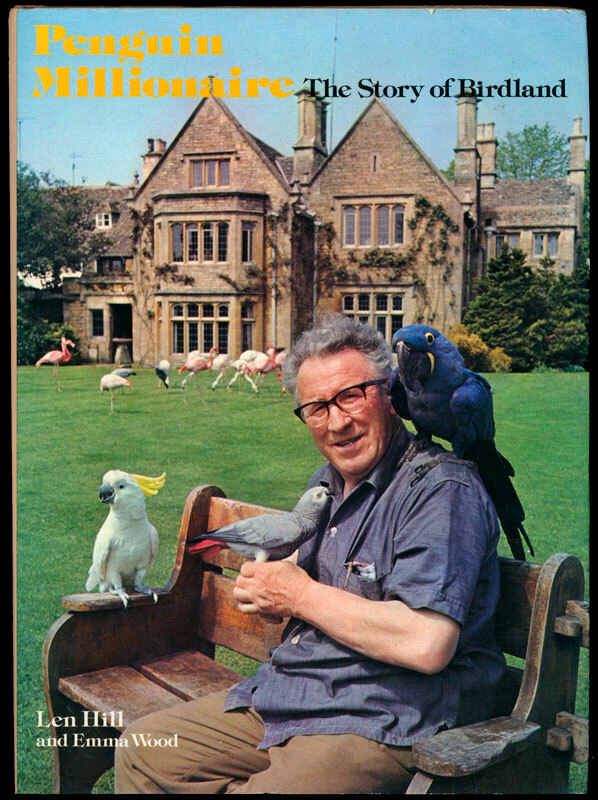
Penguin millionaire - Len Hill's...
Wanting only the best for his new territories, Hill approached Harrison & Sons, the London security printer established in 1750 and which had printed its first stamp, an Inland Revenue 1d for Montserrat, in 1866 and had produced Britain's first Christmas issue on the specially designed Jumelle press 100 years later.
The Jason Island stamps were printed by lithography in sheets of 50 and denominated 2/- with inscriptions CONSERVATION YEAR 1970’ at top and GRAND & STEEPLE at right. A portrait of Len Hill appears with the islands in the background and at left a group of Gentoo penguins, one prominently in the foreground. The Council of Europe had formally announced in 1966 that the year 1970 would be European Conservation Year and linking the stamps to the campaign to enhance awareness of the importance and necessity of protecting and conserving the environment and its natural resources was a canny decision.
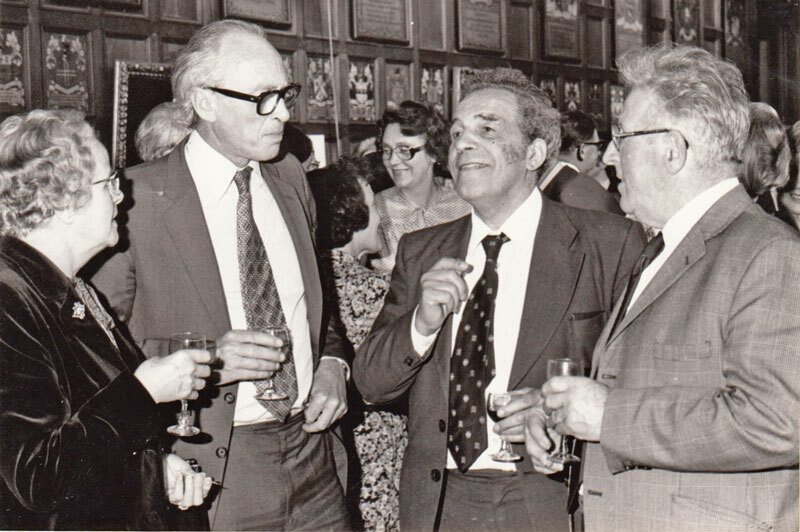
Len Hill (second right) with Nicholas...
In 1972 Hill returned with a team from the BBC Television Unit to film a programme in the World About Us series, created by David Attenborough, to be titled Penguin Millionaire, a title that Hill later adopted for his published autobiography. An arrangement had been made for the BBC equipment to arrive by an Argentine amphibian Albatross aircraft but this was trumped by an offer to travel from Stanley in HMS Endurance and be dropped off by helicopter. The hut which Hill and Strange had stayed in previously had been blown away in a gale but a large sheep shearing hut served as accommodation for Hill and the BBC crew. The finished programme first aired on 9 June1974.
Toward the end of the 1970s Hill issued private banknotes in a second attempt to raise money for his conservation activities. Again he used Harrison & Sons to produce for the Jasons by lithography five denominations in a common design in ascending size and different colours. The notes are a 50p green, £1 violet, £5 red, £10 blue and £20 brown. Each features Hill, his signature as ADMINISTRATOR and a different local species of penguin. The reverse sides of the notes carry the same design, with differences for the denomination, and include a vignette of one of the Islands with a statement that they are VALID UNTIL 31 DECEMBER 1979, cleverly preventing any later monetary claim.
The Falkland Islands authorities took no action against the production of either the stamps or the notes, sensibly viewing their issue as a private sector initiative causing no great harm to the Islands'economy.
Hill was not able to make a further visit to his islands until January 1979.
All the delays were soon forgotten when I was dropped off the MV Forrest gantry into the sea opposite the huts on Grand Jason in my Argocat (an eight wheel all terrain vehicle ), nick-named by Mrs. Barton the 'Bathtub', which is a marvellous machine, and with certain additions, I hope to bring a further one down on my next visit as it was so invaluable and seemed to cause a lot of interest.(personal letter to Governor James PARKER 2 March 1979)
On this visit Hill returned with rockhopper penguins, johnny rooks (striated caracara), king cormorants and rock cormorants and even appealed to the Governor that
If it is at all possible for the RRS Bransfield or one of the ships to bring me up some King penguins when they are coming here direct as I was unable to collect my full complement of birds granted me on the licence and my cases are left in Nutt Goodwin's garage just in case (Ibid).
Press reports that Hill planned to build a £60,000 hotel on one of the islands for bird watchers prepared to pay hefty charges were wide of the mark and the islands remained a private reserve although Hill did supply birds to other conservation parks in return for specimens that would diversify the range of species at Birdland.
The editor of Penguin News, Graham Bound, visited the Gloucestershire zoo gardens and reported on his experience (The Penguin News no. 9, Oct 23 1980, pp 14-16). There he found Hill
Operating the till and issuing the tickets.It was obviously him as he had a huge Long John Silver type parrot sitting on his shoulder, quietly nibbling his ear.
Hill confirmed to Bound his plans to set up a year round station for scientists and airstrips on the islands and a personal intention to purchase a house in Stanley as a base. Stanley House being, his intended target but little time remained to him.
Len Hill died on 3 December1981,his death reported by Ronnie Spafford in The Upland Goose in these words (UG Vol VI No 3, p 78 Mar 1982).
Seventy year-old Len Hill, owner of the Jason Islands and Bird Land at Bourton-on-the Water in Gloucestershire, also author of the book Penguin Millionaire his autobiography, was found dead in his seat, when the aircraft in which he was travelling from the Falklands landed at Madrid. His fourteen year old grandson was travelling with him at the time.
The irony of a man, so fond of birds, leaving this earthly realm whilst in the air seems bizarrely appropriate. At his father's request, Len's son Richard later returned to the Falklands to honour his father's wish that his ashes should be scattered from the Islands' cliffs.
Birdland had previously attracted worldwide attention with the first hatching there of Humboldt and Magellanic penguins. Whilst on the Jasons with his grandfather, Len's grandson, Nicholas had discovered an egg in an abandoned nest and brought it carefully back to England. After a period in the Birdland incubator the park was in the news again with the announcement of the first successful breeding of an albatross in captivity.
External links
For Penguin Millionaire see YouTube video: https://www.youtube.com/results?search_query=penguin+millionaire
References
Len Hill & Emma Wood, Penguin Millionaire (1976), ISBN 0 7153, David and Charles
Comments
Revisions
August 2026 Biography first added to Dictionary