LAWRENCE, STUART JAMES
1944-2026 from England
Master Mariner, Captain Stuart James Lawrence MBE was born in Grimsby (Lincolnshire) in 1944, the son of Hiram Roy Lawrence, (known as Roy), who worked as a marine supplier. His grandfather, Hiram Lawrence, founded the Great Grimsby Marine Stores in the 1920s - a marine supply business dealing in rope, canvas and scrap – thus maintaining the family’s connection with the town’s docks and shipping. Stuart attended Nunsthorpe School and later the Grimsby Nautical College (Founded in 1879 it trained young seafarers and fishermen for Ministry of Transport certificates with uniformed courses and practical seamanship). As he grew up and was educated in Grimsby, Lawrence’s fascination with the sea began in early childhood. At the age of five he is reputed to have declared to a neighbour that he wanted to be an Admiral. He lived opposite Peter Jackson, who later became one of the captains of the Cunard liner Queen Elizabeth 2. A contemporary newspaper report in 1950s identified this neighbour as an early influence on Stuart’s maritime ambitions.
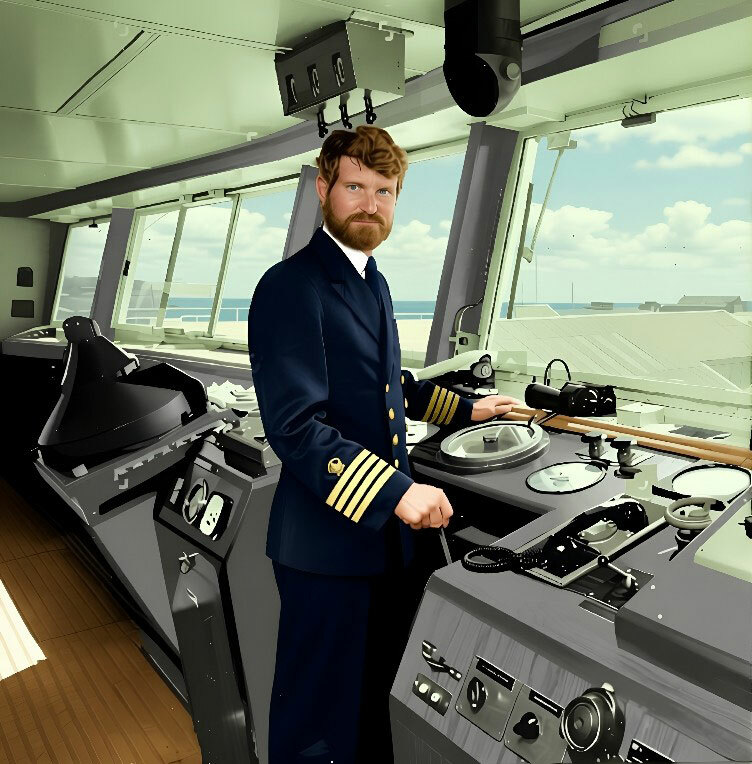
Stuart Lawrence as the Master of the...
In 1952 Stuart attended Stamford School and in 1957 he went to HMS Conway Merchant Navy Cadet School. On his seventeenth birthday, in December 1960, he left Conway and joined the Canadian Pacific Line as a cadet. His first ship was Beaverdell which ran between Southampton and Newfoundland. During the next ten years he gradually worked his way up through the company, finally obtaining his Master’s Certificate. During this time, he first experienced working on a ship in ice conditions while sailing on the Great Lakes and the St Lawrence River.
After ten years with Canadian Pacific Line, Lawrence felt it right to consider a move. In a conversation with Rear Admiral Sir Edmund Irving (1910-1990) - the former Hydrographer of the Royal Navy Lawrence talked about the possibility of joining the staff of the Royal National Lifeboat Institution (RNLI) staff – but Irvin said, ‘no, you must take the British Antarctic Survey (BAS) berth’. Thus, Lawrence joined the BAS staff and in August 1970 he joined the crew of RRS John Biscoe at Thornycroft’s Yard at Northam, in Southampton, as Second Officer.
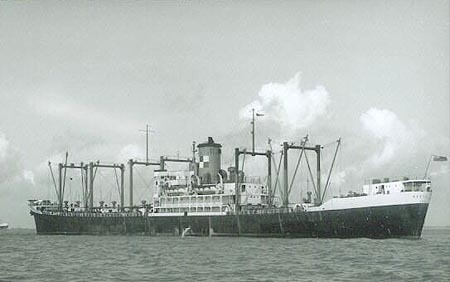
Lawrences' first ship - the ...
After two seasons in the south Lawrence joined RRS Bransfield (the new logistics ship for BAS) as Chief Officer under Captain Chris Elliot MBE (b. 1945) (Elliot served as ship’s officer and captain for the British Antarctic Survey (BAS) from 1966 to 2006). When Elliot took part in the Whitbread Round the World Race, Lawrence was appointed Temporary Master of Bransfield for the 1972 season. When Captain Tom Woodfield OBE (d.2023) (who served with the Falkland Islands Dependencies Survey (FIDS) and BAS from 1955 to 1974) left BAS to become an Elder Brother of Trinity House in 1974 the opportunity for promotion to permanent Master became available. Lawrence’s first voyage as Captain of the Bransfield was in 1975. A Falkland Islands resident echoes the widespread high regard that Lawrence was held in the community when he commented:
Stuart’s first voyage south on RRS John Biscoe was when I was working for BAS in Stanley and when BAS Office was closed down, I travelled to England on the RRS Bransfield on his first voyage as Captain in 1975 and dealt with him regularly whilst I was at Stanley Services Ltd. I always found him a very genial and gifted man who could handle effortlessly people from the bottom to the top of the tree.
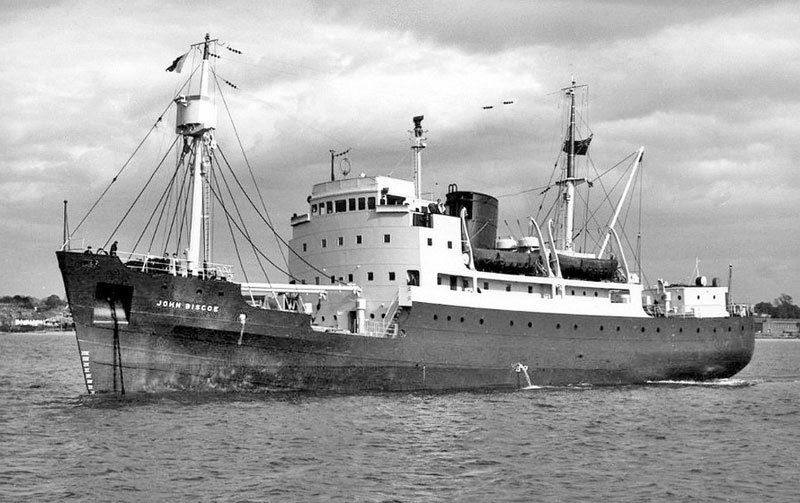
RRS John Biscoe
Following the retirement of Sir Vivian FUCHS (1908-1999) as the Director of BAS, his successor Richard LAWS (1926-2013) and Lawrence formed a remarkable partnership for many years, and Lawrence was soon appointed as one of the joint Master of the Bransfield - a responsibility he shared with the Captain John Cole OBE (b. 1935) (Cole’s service with BAS spanned from 1960 to 1972 and 1974 to 1995).
During a trip in 1980 BAS allowed Lawrence’s wife Sue to accompany him on a voyage south.
During the early stages of the Falklands Conflict in 1982 Bransfield played an important role in providing information to the Royal Navy through communications with BAS headquarters. Lawrence deliberately withheld his vessel's position from Argentine authorities while navigating the Magellan Strait to protect his mission and crew.
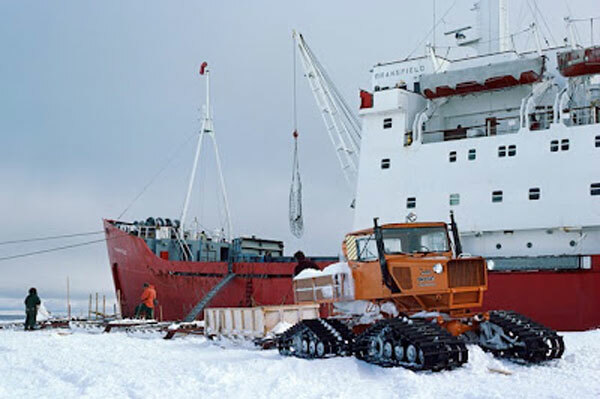
RRS Bransfield unloading stores
Bransfield served BAS for 29 years delivering food, scientific instruments, building materials, and personnel to Antarctic research stations. There was an onboard hospital. Lawrence served as one of the Masters for the whole of this period, but the ship had become very expensive to maintain. Its final voyage departed Grimsby in October 1998 and returned in May 1999. The ship was sold to GC Rieber Shipping in 1999 and renamed Igenpearl, before being broken up for scrap in Mumbai, India, in 2000.
The retirement of Bransfield was marked by a ceremony at Grimsby Docks, bringing his Antarctic career back to the town with which he remained closely associated. Lawrence commented: ‘Speaking as a Grimsby man, it was very pleasing to see the crowds waiting. We have a lot of affection and a lot of time for Grimsby.’ Lawrence maintained this heritage throughout his career, often ensuring his crew reflected his hometown roots. ‘During one notable return of the Bransfield after a seven-month deployment, 21 out of the 39 crew members on board hailed from Grimsby. The vessel itself made several celebrated visits back to the Grimsby docks in 1986, 1992, and 1998.’ (Grimsby and Cleethorpes Museum)
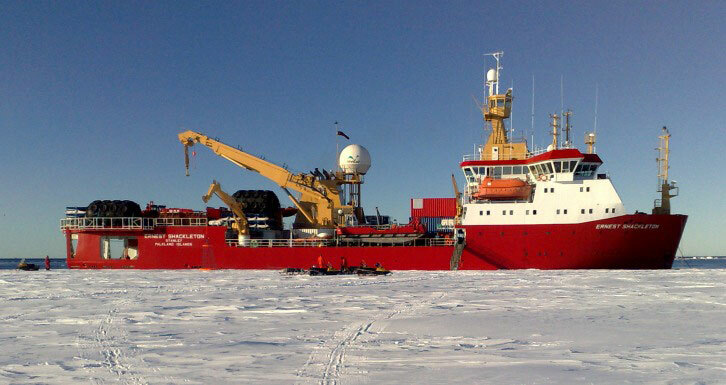
RRS Ernest Shackleton
Lawrence was appointed an alternate Master of the RRS Ernest Shackleton in 1999. He decided to retire from BAS in 2003, but his wife, Sue, was taken seriously ill in 2002 and he took leave of absence to nurse her. Sue Lawrence died in December 2002. Lawrence had one more trip south with BAS when he took his wife’s ashes to scatter them where she had visited in 1980.
Lawrence finally retired from BAS in 2003 having completed 33 annual summer voyages to Antarctica. Lawrence was awarded the Polar Medal in 1983 for his work in Antarctica and appointed MBE in the 1998 Queen’s Birthday Honours for his services to Antarctic expeditions. In 1984, a geographical feature in Antarctica, the Lawrence Channel, was named in his honour, providing a permanent link between his name and the continent where he spent so much of his working life. Lawrence was also awarded the South Atlantic Medal (1982) and the Royal Naval Reserve Long Service medal.
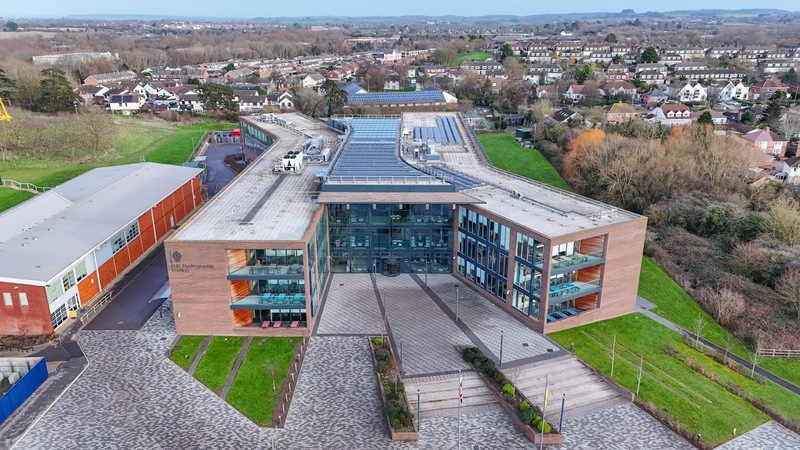
UK Hydrographic Office in Taunton
The affection and regard that BAS ships’ Captains, like Stuart Lawrence, and the BAS ships themselves, which were held by the people of the Falkland Islands, cannot be overstated. They were very much part of the Stanley scene. The ships have been known to come to the aid of small island settlements on rare occasions when the local FIC coastal vessels were unable to take stores and fuel to remote Camp stations.
Following his retirement from BAS Lawrence did two trips for the Saga Shipping Company and one trip with P & O Carnival – both of which required the services of an experienced ice pilot. In 2005 he began working for the UK Hydrographic Office as the Sailing Directions Editor for ships working in ice conditions – particularly supporting passenger ships operating in Antarctica. During his time at the Hydrographic Office Lawrence was involved with the administration of Polar Medal awards – communicating with recipients that had been awarded the medal and to sort out when and where the medal was to be presented,In 2017, Lawrence volunteered as a watchkeeper with the National Coastwatch Institution at Gosport, Hampshire.
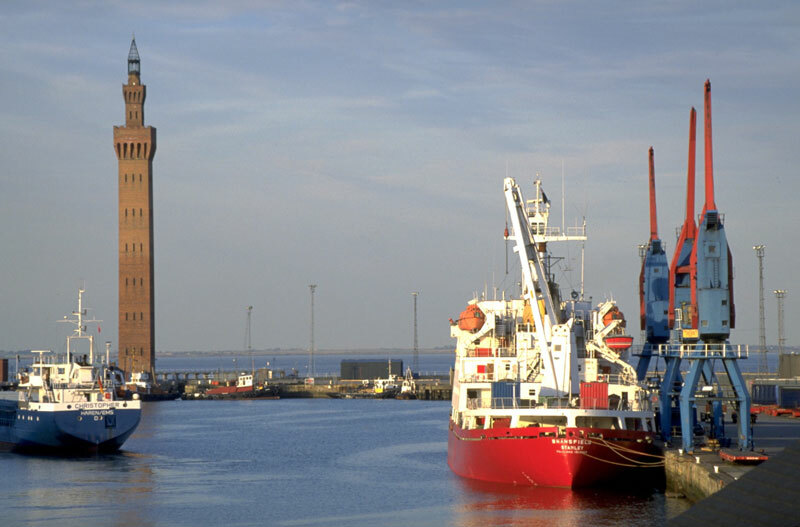
Grimsby Docks and Clock Tower with...
The local newspaper in Grimsby commented about Lawrence’s retirement from sea-going: ‘From a Grimsby childhood inspired by the sea to a lifetime supporting British scientific research in Antarctica, Captain Stuart Lawrence’s story reflects distinguished maritime service and a family heritage closely bound to the town.’
When he finally retired from sea-going Lawrence was asked if he would have still liked to have been an Admiral. ‘Yes’ he replied, ‘but he also thought he would not be tall enough to wear all those medals.’
Stuart Lawrence died suddenly in Gosport, Hampshire on 8 October 2026
References
For Stuart Lawrence's contributions to the Oral History project of the BAS Club see: https://basclub.org/oral-history/index/ad6-24-1-64/ AND ad6_24_1_64_3.pdf.
Comments
Revisions
October 2026 Biography first added to Dictionary